If you’ve been researching custom garment printing, you’ve probably encountered two methods mentioned more than any other: screen printing and DTG (Direct-to-Garment) printing. Both are capable of producing high-quality printed t-shirts and garments, but they work very differently and suit different types of orders. Understanding the distinction will help you make a more informed decision and get better results for your specific needs.
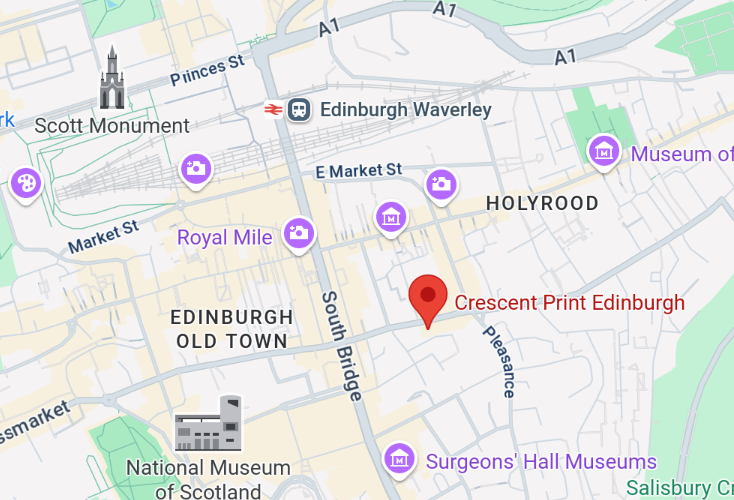
At Crescent Print in Edinburgh, we use both methods and can advise you on which is the right choice for your project. This guide explains the key differences in plain terms.
What Is Screen Printing?
Screen printing is one of the oldest printing methods in commercial use, and it remains the industry standard for garment printing at scale. The process works by creating a stencil (known as a “screen”) for each colour in the design. Ink is then pushed through the screen onto the garment, building up the design colour by colour.
The key characteristics of screen printing:
Each colour requires a separate screen, which takes time and cost to set up. This is why screen printing has a minimum viable quantity , the setup cost needs to be spread across enough garments to be economical.
The inks used in screen printing sit on top of the fabric and are typically mixed to match Pantone references, making colour accuracy extremely reliable.
Once set up, printing is fast and consistent. A screen-printed run of 100 t-shirts produces near-identical results on every garment.
Screen-printed designs are extraordinarily durable. The inks bond well with the fabric and withstand repeated washing without significant fading or cracking.
Screen printing works best on flat areas of the garment and is less suited to very small text or highly intricate fine detail.
What Is DTG Printing?
DTG printing is a more recently developed technology that applies ink directly to the fabric using inkjet-style print heads , hence the name “direct-to-garment.” Think of it as a specialist printer designed specifically for clothing.
The key characteristics of DTG printing:
There is no setup cost for individual colours or designs. Every garment is essentially “printed” fresh, like a document from a standard printer.
DTG handles unlimited colours, gradients, and photographic images with ease. Full-colour complexity that would be prohibitively expensive in screen printing is entirely practical with DTG.
Because there’s no setup cost, DTG is cost-effective for small quantities , including single items. The price per garment stays relatively consistent whether you order one or twenty.
DTG is most effective on 100% cotton garments, particularly light-coloured ones. Printing on dark garments requires a white underbase layer, which adds a little to production time and cost but allows full-colour designs to appear vivid even on dark fabrics.
The durability of DTG prints is excellent when care instructions are followed, though some users perceive screen printing as marginally more wash-resistant over time.
Head-to-Head Comparison
Let’s look at how the two methods compare across the key decision factors:
Quantity: Screen printing becomes more economical above approximately 20–30 garments; DTG is more cost-effective for smaller runs.
Colours: DTG has no limitations on colour count; screen printing charges per colour added.
Design complexity: DTG handles photographic and full-colour designs effortlessly; screen printing excels with bold, graphic designs in limited colours.
Colour accuracy: Screen printing with Pantone matching is the most precise; DTG is excellent but colour accuracy varies slightly with fabric type.
Turnaround: DTG can be faster for small orders with no setup; screen printing requires screen preparation time.
Durability: Both produce durable, long-lasting prints when produced correctly and cared for properly.
Cost at scale: Screen printing wins clearly for larger quantities; DTG is more economical for small runs.
Which Method Should You Choose?
The honest answer is: it depends on your order.
Choose screen printing if:You’re ordering 30 or more garmentsYour design uses five or fewer solid coloursExact colour matching (e.g., to Pantone brand colours) is importantYou want the most cost-effective rate for a larger runLong-term wash durability is a priority (e.g., workwear)
Choose DTG if:You’re ordering fewer than 30 garments, or even just oneYour design is full-colour, photographic, or has gradientsYou want to print multiple different designs without additional costYou need a quick turnaround with no setup delayYou want to print on dark garments with full-colour designs
Hybrid Approaches
Some orders benefit from elements of both methods. For example, a business might use screen printing for their main team uniform run and DTG for individual replacement garments added later. Or an event organiser might screen-print the majority of an event t-shirt run but use DTG for a small number of personalised versions.
At Crescent Print, we’ll always recommend the most appropriate method , or combination of methods , for your specific project. We don’t push one technology over another; we recommend what will give you the best result for your brief and budget.
Get in touch via crescentprint.pro or visit our Edinburgh shop to discuss your printing requirements, and we’ll advise on the best approach for your order.